“What’s the downtime going to be like?” It’s usually the first question I get when someone starts thinking seriously about a chemical peel.
Honestly, it depends on which peel you choose. At Collab Medspa, we offer a few different options because no two clients have the same skin, schedule, or goals. Some people want to walk out the door and go about their week like nothing happened. Others are perfectly fine trading a few days of visible peeling for more dramatic results.
Whatever your situation, there’s likely a peel that fits it. That’s exactly what we figure out together during your consultation — the treatment that works with your skin and your life, not against it.
It Really Comes Down to Which Peel You Choose
We offer two peels that most clients ask about, and they have very different recovery experiences.
iS Clinical Prodigy Peel
The Prodigy Peel is a superficial peel, and it’s a favorite for clients who want that brighter, smoother look without much interruption to their routine.
Most people don’t see any visible peeling at all. What they notice instead is that their skin feels smoother and looks healthier, with a glow that builds over the following days.
I tend to recommend this one if you:
- Want a brighter, more even complexion.
- Are dealing with mild congestion.
- Are looking for gentle, ongoing skin renewal.
- Can’t take several days of obvious peeling.
It also happens to be one of my favorite treatments to pair with a microneedling series. The two work on your skin in different ways, so together they tend to produce results that neither one achieves alone.
VI Peel Downtime
The VI Peel is a different animal. It’s a moderate-depth peel that goes deeper into the skin, and it’s the one I reach for most often when clients are dealing with:
- Sun damage
- Hyperpigmentation
- Melasma
- Acne scars
- Acne-prone skin
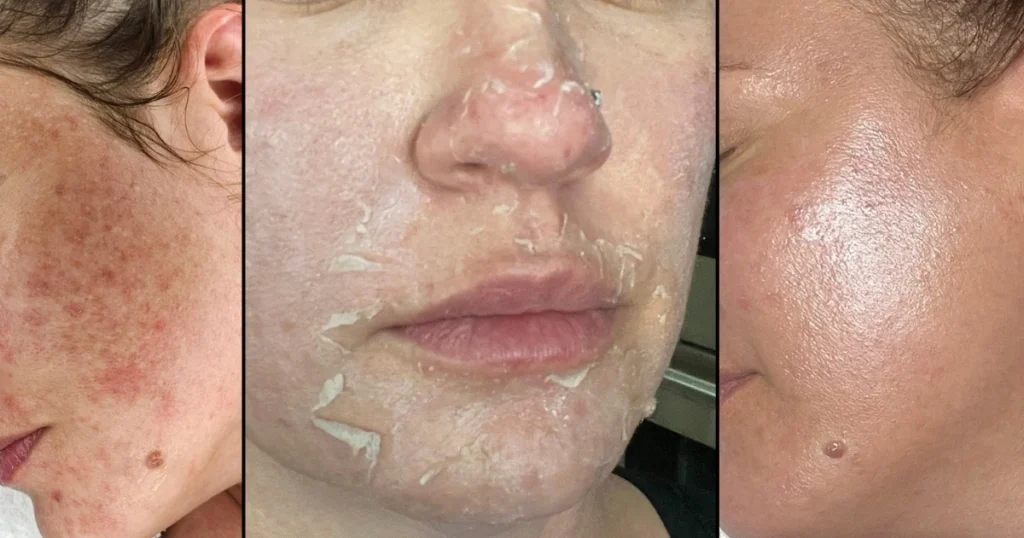
Peeling typically kicks in around day three and wraps up by day seven. Every client heals a little differently, but here’s roughly what to expect:
- Days 1–2: Skin feels tight, maybe a shade darker than usual.
- Days 3–5: Peeling starts around the mouth and spreads outward from there.
- Days 5–7: Peeling slows down and the new skin underneath starts showing through.
It can look pretty dramatic in the mirror, but this is exactly how it’s supposed to go.
So, When Can You Get Back to Normal Life?
This is the question I probably field the most.
I don’t give everyone the same answer, because it really depends on your day-to-day. If you work from home, a little visible peeling might not bother you at all. If your job puts you face-to-face with people constantly, you may want to plan your peel around a few days off.
Exercise comes up a lot too. If hot yoga or intense workouts are part of your week, we’ll talk through how to work a short break into your schedule before we book anything.
My philosophy is simple: the more you know going in, the easier the whole thing feels. Planning ahead turns “getting through it” into just… going through your week.
The Biggest Myth I Hear About Chemical Peels
Here’s one I correct constantly: you don’t have to visibly peel for the treatment to be working.
Your skin sheds in its own natural cycle, and where you happen to be in that cycle when we do your peel affects how much flaking you’ll actually see. Some clients peel a lot. Some barely peel at all.
Either way, the treatment is doing its job underneath the surface.
I always tell clients not to judge results by how much skin comes off. The changes that matter are happening well below what you can see.
A Story That Stuck With Me
I had a client who wanted better skin for years but kept putting off a VI Peel — she just couldn’t stomach the idea of people seeing her peel. Rather than push her into something she wasn’t ready for, we started her on a series of iS Clinical Prodigy Peels instead. She loved how her skin responded, and that experience gave her the confidence to eventually try the VI Peel.
When she finally did, she told me the peeling wasn’t nearly as bad as she’d built it up to be in her head. And she was thrilled with how bright and healthy her skin looked afterward. That’s stuck with me because it’s proof of something I believe pretty firmly: the right treatment plan is the one that fits your life — not a one-size-fits-all recommendation.
How We Keep Recovery Smooth
We spend real time on post-care instructions, because how you treat your skin afterward matters just as much as the peel itself. That means steering clear of:
- Picking at loose or peeling skin.
- Heavy sweating too soon after treatment.
- Sun exposure.
- Skipping sunscreen.
- Any products we didn’t specifically recommend.
Clients who follow this guidance rarely run into complications.
Occasionally someone notices a few small whiteheads pop up after a peel. That’s usually not a breakout — it’s just trapped debris working its way to the surface as the old skin sheds. We often suggest a facial before your peel and keeping things like pillowcases and towels fresh afterward, since small habits like that really do make a difference.
Why I Usually Recommend a Series, Not Just One Peel
A lot of clients come in wanting to “just try one” peel first, and that’s a completely fair place to start. But I’ll be upfront: the best results tend to come from a series done every 4 to 6 weeks, not a single treatment.
This isn’t about upselling you. It’s about making sure you actually get the results you’re paying for. When clients stick to the recommended schedule, we consistently see skin that’s healthier, brighter, and smoother than what one treatment alone can deliver — and I want everyone to feel like they got their money’s worth.
How We Decide Which Peel Is Right for You
Choosing the right peel is about more than just your skin type. The a few things we need to consider:
- How much correction you want for your skin
- Your lifestyle.
- Your budget.
There are a lot of Peel options out there and we wanted to offer the best options at Collab Medspa. We wanted there to be a genuinely good option for everyone who walks through the door.
If your skin is already fairly healthy and you’re after more glow, smoother texture, or less congestion, the iS Clinical Prodigy Peel is usually the right call.
If you’re dealing with melasma, pigmentation, acne scarring, or stubborn acne, I’ll typically point you toward the VI Peel — it just produces faster, more noticeable change for those specific concerns.
There’s no universal right answer here. The best peel is whichever one matches your goals, your schedule, and your comfort level.
My Best Advice Before Your First Peel
Honestly? The best prep isn’t a skincare product — it’s your mindset.
Yes, peeling can be a little annoying. But if you go in expecting it, it stops feeling like a problem and starts feeling like part of the process.
Funny enough, the days when peeling feels most bothersome are usually the same days the fresh, healthy skin underneath starts to show. That moment makes it worth it.
Go in with the right expectations, and the whole experience gets a lot easier — and the results tend to feel that much more rewarding.
Ready to Find the Right Chemical Peel?
If you’re not sure which peel makes sense for you, let’s figure it out together. Every treatment at Collab Medspa starts with a personalized skin consultation, where we take the time to understand your skin, your schedule, your budget, and what you’re actually hoping to achieve.
Whether that ends up being the gentle iS Clinical Prodigy Peel or the more advanced VI Peel, the goal is the same either way: healthy, glowing skin, with a plan built around your life.