If you’ve been thinking about microneedling, you’ve probably asked the same question almost everyone asks me before their first appointment: does it hurt?
Honestly? You’ll feel it. But probably not in the way you’re picturing.
I tell every first-time client the same thing: it’s not pleasant, but it’s not painful. That one sentence usually does more to calm someone down than anything else I could say. And most people are surprised to learn we apply a medical-grade compounded numbing cream before we even pick up a device. I can watch the tension leave their shoulders the second I mention it.
After doing this for years, the thing I hear most often afterward isn’t “that was awful.” It’s “wait, that’s it?”
It Doesn’t Feel the Same Everywhere
Your face isn’t one uniform surface, and microneedling doesn’t feel like one uniform experience.
The cheeks are usually the easy part — most people say they barely notice anything there. The forehead is a little different. It’s not painful, exactly, but because there’s less tissue between the skin and the bone, it can feel odd in a way clients struggle to describe. The nose and upper lip tend to be the most sensitive spots, and yes, We’ve had more than one client fight off a sneeze mid-treatment.
The neck picks up a bit more sensation, while the chest — the décolleté, if you want the technical term — is usually one of the most comfortable areas to treat.
Part of the reason it feels different everywhere is that we’re not using the same needle depth across the whole face. Your cheek skin isn’t built like your forehead skin, and it’s definitely not built like the skin around your eyes. Treating it all the same way wouldn’t just be more uncomfortable — it would be unsafe.
What Actually Makes It Comfortable
A lot of comfort just comes down to knowing what’s coming.
Before we start, we walk through exactly what the appointment will look like, step by step. That alone takes a lot of the edge off. Once the numbing cream comes off, we move efficiently, because the goal is to get through the treatment while your skin is still fully numb, not to drag it out.
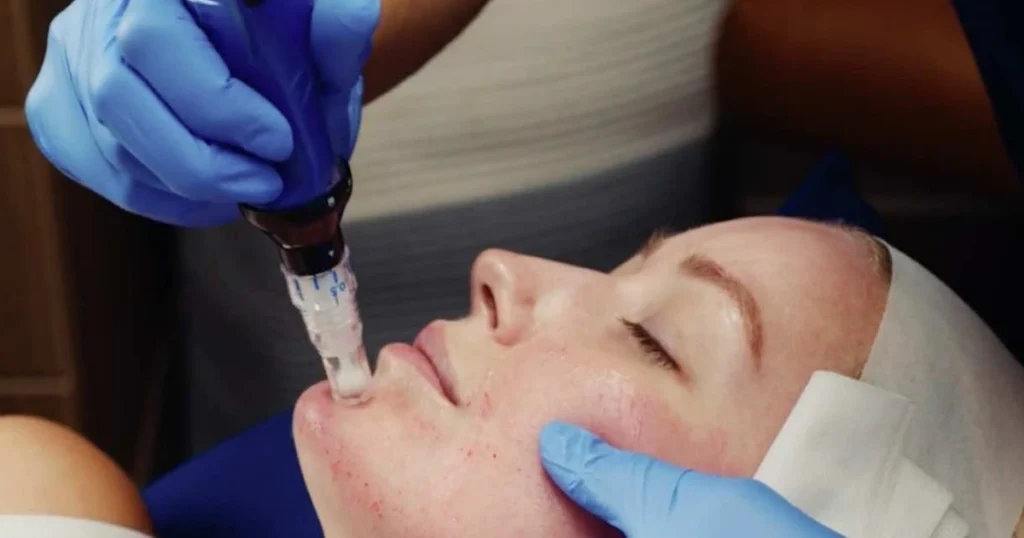
And we’re checking in with you the whole time. Depth isn’t a fixed setting — we’re adjusting based on how you’re feeling, how your skin is responding, and whether we’ve hit the clinical endpoint we’re looking for: healthy redness, called erythema, and sometimes tiny pinpoint spots of bleeding. That’s how we know the treatment is doing its job without pushing past what the skin needs.
We also try to make the room itself feel calmer. Warm blankets, a stress ball if you want one, and a little vibrating tool that gives your nervous system something else to focus on. Most clients tell me those things do more for their stress than for any actual pain — but that’s exactly the point.
The Client Who Changed their mind about PRP Microneedling
I still think about one conversation more than almost any other.
A client had PRP microneedling done years earlier, and the experience stuck with her enough that she put off using the last session in her package for years. When she finally came back in, she wasn’t expecting much to be different.
Afterward, she looked at me and said it hadn’t hurt at all, she was shocked!
We got to talking, and it came down to the numbing cream. A few years back, I’d spent some time testing better formulas, mostly because I’m always looking for small ways to improve the experience. Since we switched, it’s come up unprompted more times than I can count.
She doesn’t dread booking her appointments anymore. That made me so happy and validated why we are always looking to improve our treatments and tools!
The Comparison I Wish People Would Stop Making
The biggest misconception I run into is people comparing what we do to at-home rollers or drugstore devices.
They’re not in the same category. Home tools aren’t built to reach the depth professional equipment reaches, they’re often duller than they should be, they’re hard to keep properly sterile, and most people using them skip numbing cream entirely.
Then there’s the other myth — the dramatic before-and-after photos online with faces covered in blood. That’s not what a well-done treatment looks like. Skin should come out red, not bloody. Redness tells us the skin is responding the way it should. Excess bleeding doesn’t mean better results — it usually just means more injury than necessary.
More Depth Isn’t Automatically Better
There’s a common assumption that deeper needles equal better results. It doesn’t work that way.
Skin thickness changes from one part of your face to another — your cheeks can typically handle more depth than your forehead can. Push too aggressively in a delicate area and you’re not improving results, you’re just causing damage that didn’t need to happen.
This is really why the provider matters as much as the device. Microneedling isn’t just running a tool across skin — it’s understanding anatomy, thickness, your specific goals, and how your skin is reacting in real time.
Talk to Us — Genuinely
If I could give first-timers one piece of advice, it’s this: say something.
Tell us if you’re nervous going in. Tell us how you’re feeling mid-treatment. Tell us how your skin reacts afterward. None of that is oversharing — it’s exactly the information that lets us adjust and make the next visit even better.
So, Is It Worth It?
Yes. Without hesitation.
If someone asks whether microneedling is worth a bit of temporary discomfort, my answer doesn’t change: absolutely, one hundred percent. And the first treatment is usually the hardest part — once you know what to expect, everything after that feels easier.
The results are what make it worth talking about in the first place. Acne scars, fine lines, enlarged pores, overall texture — microneedling works by encouraging your own skin to produce new collagen, and that shows up over time in a way that’s hard to fake. Watching that confidence shift in clients is genuinely one of my favorite parts of this job.
If you’re a good candidate, I think it’s one of the better investments you can make in your skin.
Curious to Try It Yourself?
If microneedling has been on your mind but the discomfort has held you back, let’s talk it through.
At Collab Medspa, every treatment is built around your skin, your comfort, and what you’re actually trying to achieve. Great results should come with a great experience — not one instead of the other.