Everyone has an opinion about retinol. When to start it. How often to use it. Which product is “the best one.” Scroll social media for five minutes and you’ll find a dozen confident answers, all slightly different.
Here at Collab Medspa, we genuinely love retinol — for the right client, in the right amount. But we also see the fallout when someone jumps in too fast, grabs a product that’s way too strong for where their skin actually is, or layers retinol onto skin that’s already dry and unhappy.
So let’s slow down and talk about what retinol really does.
At its core, retinol is a form of vitamin A. It speeds up cell turnover and gives collagen a bit of support. Over time, that combination can smooth out fine lines, even out texture and tone, and generally help skin look more like itself, just refreshed. It can also help keep pores from getting clogged in the first place.
But here’s the thing we want you to walk away with: more retinol is not automatically better.
What Does Retinol Do for Aging Skin?
As we get older, a lot of what our skin used to do effortlessly starts to slow down — cell turnover included.
Picture cell turnover as your skin quietly renewing itself in the background: older cells shed, newer ones rise to the surface. Retinol gives that process a nudge, which is why skin often looks smoother and brighter once it’s part of the routine.
It also lends a hand to collagen, the stuff that gives skin its firmness and bounce. Research on retinoids backs this up, showing real improvement in fine wrinkles and other signs of sun-related aging.
That’s a big part of why retinol tends to come up so often when we’re working with clients focused on aging gracefully.
Does Retinol Actually Help With Fine Lines and Wrinkles?
It does — this is really the headline reason most people reach for it.
Because retinol supports both renewal and collagen, it can soften fine lines and improve texture over time. Studies show retinol itself can improve fine wrinkles, and retinoids as a family have decades of track record treating photoaged skin.
That said, don’t expect overnight magic. This is a slow build.
Consistency beats intensity here. A milder retinol you can actually stick with will outperform a harsh one that leaves your skin too irritated to tolerate.
Can Retinol Help With Pores and Blackheads?
Yes and this surprises some people who think of retinol strictly as an anti-aging ingredient.
Retinoids help stop dead skin cells from piling up and clogging pores, which in turn can ease blackheads and refine how pores look overall.
So no, retinol isn’t just for acne, and it isn’t just for aging skin either. It’s genuinely useful for both, and often for neither in isolation — it just depends on you.
What matters most is the person in front of us: your age, your skin type, your current routine, your goals, and how resilient (or fragile) your skin barrier is right now.
Is It Possible to Use Too Much Retinol?
YES! – and honestly, we see this more than almost any other mistake.
The pattern usually looks like this: someone gets excited, buys a strong formula, and starts using it nearly every night right out of the gate. A few weeks later, their skin is dry, flaky, red, and uncomfortable.
That’s not a coincidence. Retinoids are known to cause dryness, peeling, redness, burning, and stinging, particularly when the skin hasn’t been given time to adjust to the strength or frequency being used.
When a client comes to us with this issue, our first question is almost always the same: “Walk me through exactly what you’re using, and how often.”
More often than not, the fix isn’t complicated. We dial back the frequency, bring in a richer moisturizer, and make sure daily SPF isn’t being skipped.
Quitting retinol altogether usually isn’t the answer, but using is smarter is.
A Retinol Success Story
One client came to us already receiving treatments for aging skin, hoping to level up her at-home routine with retinol.
She’d tried two different products she found on her own beforehand. One did basically nothing. The other made her skin itch almost immediately. Understandably, she assumed retinol was not the answer for her.
We convince her to try iS Clinical’s retinol line and, just as important, had her ease in gradually instead of diving in headfirst. About a month later, she told us her skin felt firmer and looked noticeably brighter.
Her story is a good reminder: the problem often isn’t retinol itself. It’s the formula, the strength, the frequency, and everything else happening around it in the routine.
When Retinol Backfires
We’ve also seen this go the other way.
A client in her early twenties came in for her very first facial. A friend had told her about retinol, and she wanted to get ahead of aging before it even started.
The problem? She was using it far too often for skin that young and untrained to actives.
Her skin was severely dry and dehydrated — dry enough that it had started taking on a crepey texture. Instead of looking younger, her skin was starting to look tired and stressed. We talked through what was likely happening and had her pause the retinol completely. We swapped her moisturizer for something more supportive and focused purely on getting her skin barrier healthy again.
Eventually, retinol could potentially come back into the picture — slowly, and at a much lower frequency than before – and maybe not at all for a while, until her skin actually needs it.
She also joined our membership for regular facials, and within a couple of months, her skin looked like a completely different story.
It’s proof of something we say constantly: There really can be too much of a good thing.
Are People Starting Retinol Too Young?
Here’s where we’ll diverge a bit from what you might see trending online.
We don’t think every 19-year-old needs retinol just because it’s having a moment on social media. If your skin is young and healthy, an aggressive anti-aging routine might not be what it actually needs right now — there may be simpler, more appropriate things to focus on.
That said, age isn’t the only factor that decides whether a retinoid makes sense. Retinoids are also used for acne, regardless of age.
Our approach at Collab Medspa isn’t “everyone needs this trending ingredient.” It’s look at your skin, and your goals, and go from there.
When Should You Hold Off on Retinol?
If your skin is already very dry, irritated, or your barrier seems compromised, that needs attention first – before retinol enters the picture at all. Adding a strong active to skin that’s already struggling tends to make things worse, not better.
The American Academy of Dermatology echoes this too, noting that people dealing with significant dryness, redness, or inflammation may not be good candidates for retinoids without guidance from a professional.
In short: calm, healthy skin comes first. Retinol comes after.
How to Actually Start Using Retinol
New to retinol? Go slow. Genuinely slow. – Here’s a simple beginner framework we often walk clients through:
Weeks 1–2: Use retinol about twice a week — say, Sunday and Thursday nights.
Weeks 3–4: If your skin hasn’t shown real redness, irritation, or peeling, you can move toward every other night.
After that: Some people can build up further from there. But you don’t need to be using retinol every single night to have a great skin care routine — your ideal frequency comes down to your skin, your product, and its strength.
Listen to your skin! If your skin starts burning, turns very red, or begins peeling heavily, that’s your cue to pull back, not push through.
What Should Go Alongside Retinol?
We recommend applying retinol at night, then following it with a solid moisturizer.
That moisturizer step isn’t optional — retinol is drying by nature, and pairing it with hydration is one of the most reliable ways dermatologists recommend for cutting down on irritation.
It’s also worth being careful about how many actives you’re combining. If you’re already using exfoliating acids or other strong ingredients, it’s usually smarter to rotate them onto separate nights rather than stacking everything at once. Your skin doesn’t need to fight several battles simultaneously.
And of course — SPF, every. single. day! Sun protection is non-negotiable with any anti-aging routine, and it’s specifically recommended alongside retinoid use.
Which Retinol Do We Actually Recommend?
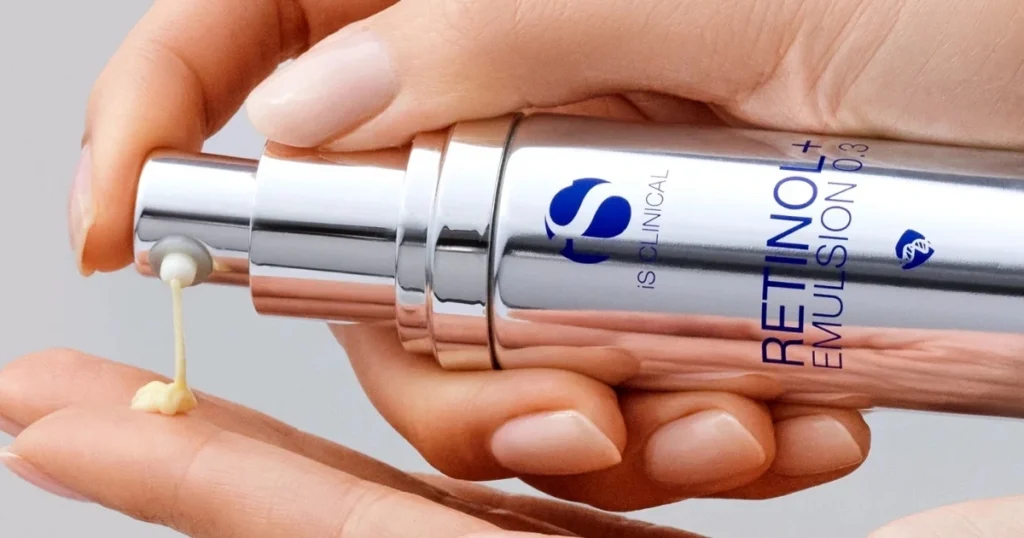
At Collab Medspa, our go-to is iS Clinical Retinol+ Emulsion, available in both the 0.3 and 1.0 strengths.
We like these formulas because they don’t put all their weight on retinol strength alone — they’re built as full emulsions designed to support the skin at the same time they’re delivering results. That balance of effectiveness and support is exactly what makes them a good fit for a lot of our clients.
But even here, stronger isn’t automatically the right call for everyone. The strength we recommend comes down to your skin, your history with retinol, and what you’re actually trying to change.
So, What’s the Right Retinol Routine for You?
The internet can tell you what retinol does in general, but it can’t look at your actual skin. That’s the real difference. At Collab Medspa, we want to know what you’re currently using, how your skin has reacted to things in the past, what treatments you’re already receiving, and what you’re actually hoping to change.
Sometimes retinol is exactly the right next step. Sometimes it just needs a different strength or frequency. And sometimes, honestly, the best thing we can tell you is: “Not yet — let’s get your skin healthy first.“
That’s the whole philosophy behind how we approach skin care: it should be personal, not one-size-fits-all.
If you’re not sure whether retinol belongs in your routine, bring what you’re currently using to your next visit. We’ll look at the full picture together and build something that actually supports your skin instead of overwhelming it.
Because with retinol, the goal was never to use the most of it. The goal is to use it correctly.
This article is for general skin care education and is not a substitute for medical advice. Retinoids are not appropriate for everyone. For example, the American Academy of Dermatology advises that retinoids should not be used during pregnancy. Book a free consultation with a provider at Collab Medspa or with an appropriate healthcare professional about questions specific to your health or skin.